
Office Introduction / Location / Address:
Pakistan is the seventh largest producer of cotton in the world. It also has Asia’s third-largest cotton spinning capacity (after China and India), making cotton Pakistan’s largest industrial sector. Cotton plays a significant role in the country’s economic development and has remained a key livelihood source for thousands of farmers.
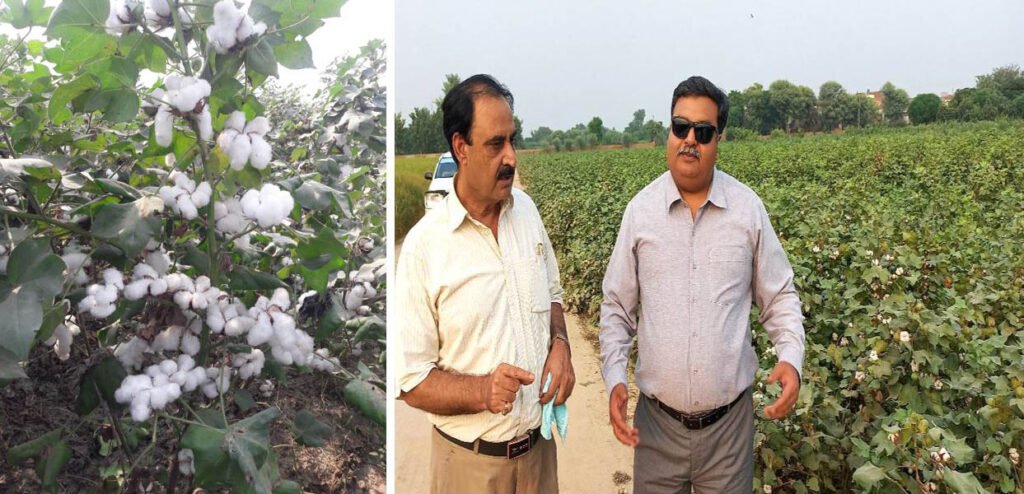
Southern Punjab (Multan, Bahawalpur, Rahim Yar Khan, and D.G. Khan Divisions), having a cotton-wheat-cotton cropping pattern, is a major belt of cotton production in Punjab. Research work on cotton was started under Cotton Research Station Lyallpur (now Faisalabad), established in 1902. There has been a continuous expansion in the cotton research system in Punjab to cater to the needs of farmers and other stakeholders. In 1935, one research sub-station was established in Multan to evaluate varieties’ performance in the relatively hotter Southern zone. Cotton Research Institute Multan is the first and the oldest cotton research center established in Southern Punjab with the main objective of developing cotton varieties, particularly for this cotton belt. Cotton Research Sub-Station, Multan, was upgraded in 1958, and in addition to testing varieties developed at Lyallpur (Faisalabad), this center was entrusted with developing varieties. The office of the Director was shifted from Faisalabad to Multan in 2016, and Cotton Research Station Multan was upgraded to Cotton Research Institute Multan in 2017. Currently, six substations are working under the umbrella of Chief Scientist/Director Cotton in Multan, Bahawalpur, Vehari, Sahiwal, Faisalabad and Khanpur. One more cotton research sub-station is also under development at Rajanpur.
Services Offered
- Training of Master Trainers of the Agriculture Extension Department
- Internship facility of undergraduates of Agriculture Universities
- Provision of Pre-basic & basic seed to Punjab Seed Corporation and other seed multiplying agencies along with Progressive Growers
- Farmer awareness through workshops/seminars, Mass Media, i.e., Radio, TV talks
- Awareness through Brochures and Pamphlets
- Field service
Facilities offered to the Farmers:
- Farmers’ Advisory (through telephone call, WhatsApp and other social media Platform)
- Distribution of literature (about cotton production and insect/pest control) to the farmers
- Production technology of cotton varieties
- Fiber Testing Lab
Departmental Strategy
Cotton Research Institute is the leading Institute engaged in developing cotton varieties in Punjab. This Institute is working on combating various upcoming biotic and abiotic threats. The cotton crop is one of the most difficult crops in terms of management point of view. In the recent years CLCuV is the most devastating biotic factor in Pakistan that results in severe losses in yield. Along with this threatening viral disease bollworms are also the second most disturbing factor during its reproductive phase. Dusky and red cotton bugs are also becoming major pests of cotton. On marginal lands requirement of drought tolerant varieties is a far cry. Keeping in view all these factors Cotton Research Institute is working on all these aspects i.e., disease resistance, insect pest resistance, drought tolerance, heat tolerance and better fiber quality. The material is being developed by employing various conventional and non-conventional techniques. Most common methods for the development of varieties being used are mass selection, pedigree selection, backcross breeding, introgression (for disease resistance) and heterosis breeding. Various agronomic trials are also being conducted to devise production technology of the developed varieties. Similarly, trials on entomological aspects are also being carried out. Detail of Experiments is given as under:
Breeding
- Maintenance and Enrichment of Germplasm
- Study of Filial Populations (F1 – F6)
- Preliminary Yield Trials (PYTs)
- Advance Yield Trials (AYTs)
- Maintenance of Gossypium species and interspecific hybridization
- Improvement of Desi cotton
- Study of Bt. and Glyphosate resistant transgenic lines
- Effect of temperature and humidity on CLCuV incidence, seed cotton yield and fibre quality
- Provincial Coordinated Cotton Trial (PCCT).
- National Coordinated Varietal Trial (NCVT).
- Fiber Trait Analysis
- Statistical Analysis
Agronomy
- Effect of different sowing dates on growth and yield of new genotypes of cotton.
- Performance of different genotypes under different planting densities.
- Impact of NPK on the growth yield and fiber quality of cotton.
- Role of different management practices on growth and yield of cotton.
- Role of organic matter on the yield of cotton by incorporating cotton sticks and wheat straw into soil
- Effect of picking time and storage period on germination of cotton seed
- Determination of efficacy of different weedicides on cotton weeds and their impact on growth and yield of cotton
- Growth Regulator Trials
- Use of Growth Hormones for the control of fruit shedding in cotton
- Varietal response study against prevailing climate change
- Effect of different mulching practices in cotton in the field conditions
- Effect of topping on seed cotton yield at different plant heights of cotton
Entomology
- Study of Varietal Behavior Against Different Insect Pests Tolerance Under Unsprayed Conditions
- Studies on the Monitoring of Insecticide Resistance in Cotton Whitefly (invitro)
- Screening of different insecticides with different brands (generic and multinational) against Pink bollworm, whitefly and dusky cotton bug
- Determination of Bt. Concentrations in Different Plant parts at different crop stages in advanced cultivars and its feeding effect on Lepidopterous larvae
- Effect of Row Spacing on the Management of whitefly
- Topping effect on dynamics of insect population, seed cotton yield and fiber quality
- Determination of number of pheromone traps per acre for effective monitoring of pink bollworm
- Monitoring of lepidopterous pests of cotton through pheromones traps at CRI., Multan
- Survey of alternate host plants of Cotton Mealybug and its Bio control agents in nine districts of Punjab (Multan, Bahawalpur, Bahawalnagar, Khanewal. Vehari, Layyah, Muzaffar Garh, D.G. Khan and Rajanpur)
- Bio-safety trial
- Efficacy of plant extracts for the control of insect pests
Strengthening of Research at CRI, Multan
- Establishment of research laboratories (MAS & CRISPR-Cas9), virology, tissue culture (regeneration), pathology (diseases, e.g., CLCuV), & physiology
- Strengthening existing research laboratories with new tools
Import of Technology
- Better leverage of global expertise
- New gene technology
- Precision agricultural tools
Capacity Building of Scientists
Scientists Work Acknowledgement:
- Establishment of a Daycare centre
- Financial benefits, e.g., awards, PBR (breeder share)
- 100% technical allowance on a competitive basis
- Honoraria & Appreciation
APTMA is not a solution for agricultural research problems nor a forum for interventions:
- The Research and Development Board, comprising all stakeholders, including farmers, scientists, industry, academia, and experts, maybe a better solution.
- 100% Filling up the vacant technical posts & supporting staff.
Social Media Links:
Contact Number / Email address:
- 061-9200337
- 061-9200339
- dircrimn@gmail.com